Types of Dizziness
Does it feel like the room is spinning around you? Do you feel unsteady with quick movements? These are common sensations that you might experience when suffering from dizziness. Dizziness can actually be further categorized as vertigo, disequilibrium, lightheadedness and presyncope.
- Vertigo is the illusion that an individual or their surroundings is moving or spinning around them, it is associated with nausea and vomiting
- Disequilibrium is the feeling of being off-balance or unsteady
- Lightheadedness is the feeling of being woozy or disconnected from one’s surroundings
- Presyncope is the feeling of losing consciousness or about to faint
What actually causes someone to feel dizzy? These different forms of dizziness can be caused by a range of issues, from certain medications, to vestibular, visual, or neurological problems. An often overlooked caused of dizziness is an issue with the cervical spine (neck), and this is called cervicogenic dizziness.
Mechanism of Cervicogenic Dizziness
How can your neck cause you to experience sensations of dizziness? In order to answer that, it is important to understand the role of the sensory system in the body. Your body is equipped with different sensory receptors that relay various kinds of information to the brain. For example, the taste buds of the tongue tell the brain if the food being eaten is sweet or salty.
When it comes to balance, there are three main tools that tell your brain where you body is in time and space. The visual/ocular system (eyes), the vestibular system (inner ear), and the proprioceptive system (muscles and joints). The eyes provide you with a visual of your surroundings. It allows you to track and fixate on objects so you don’t bump into things around you. The vestibular system is made up of sensors in the inner ear, and it constantly gives the brain information about head motion and position. Lastly, the proprioceptive system is made up of receptors embedded in your joints and muscles, and they tell the brain the location and orientation of different parts of the body. The receptors in the cervical spine have imporant connections not only to the central nervous system, but to the vestibular and visual appartus as well.
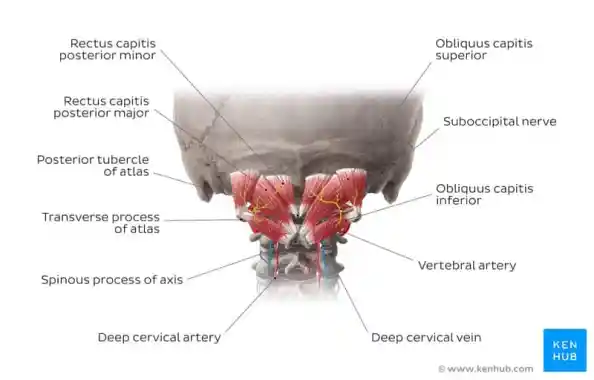
Diagram of the suboccipital muscles and surrounding structures. Image source
The proprioceptive system of the neck is very well developed, with an extremely high density of muscle spindles found in the neck muscles, specifically in the suboccipital region (below the skull). Research has shown that these muscles have 200 of these receptors per gram. Compare this to the thumb, another highly sensitive area, which has 16 muscle spindles per gram. Due to this, the upper neck (C0-C3) is thoroughly equipped to provide the brain with information about the head relative to the trunk, as well as regulating head-eye coordination and postural stability. Now, why is this important?
A structural misalignment of the upper neck will result in altered head and neck awareness, joint mechanics and improper signaling from the receptors. The ocular, vestibular, and proprioceptive systems should be telling the brain the same message. If one system is sending an aberrant message, there is what we call sensory mismatch, resulting in nausea, unsteadiness, visual disturbances and the sort.
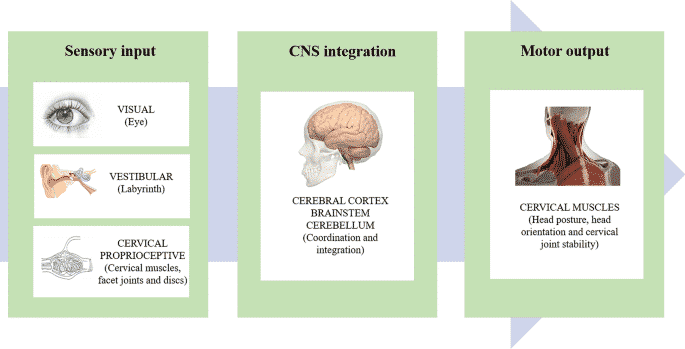
Peng et al., 2021. Schematic diagram of cervical sensorimotor control.
How to Assess for Cervicogenic Dizziness
If dizziness and neck issues coincide, there is good reason to suspect cervicogenic dizziness. Patients should undergo a thorough cervical spine examination before the neck is ruled out as a cause or contributor to their symptoms. Two special tests that can be done to evaluate cervical involvement are:
- Smooth pursuit neck torsion test: The patient’s head is stabilized in space while their eyes track a moving object. Their trunk is then rotated to the right and left. As the patient tracks the object, their eyes are monitored for slow, jumping eye movements or any increase in dizziness. If the eyes move more slowly or their dizziness is exacerbated with the trunk rotated, the test is positive for cervical involvement.
- Cervical joint position error test: The patient has a laser attached to the forehead, with the beam focused on a bullseye target on the wall. The laser starts off in the center, and the patient’s eyes are closed. The head is turned to the right or left then returned to center. When the patient is at the perceived center, the laser’s position on the bullseye target is measured. An average error range is 4.5cm. Any greater error indicates a proprioceptive issue at the neck.
Management of Cervicogenic Dizziness
In order to manage sensory mismatch, we must address causes of abnormal proprioceptive inputs. The NUCCA image-guided adjustment allows for restored joint mechanics, muscle function, and signaling at the upper cervical region. Other management strategies include balance training, eye-neck coordination exercises and neck muscle retraining, which can be co-managed with vestibular therapists or optometrists trained in vision therapy.
References:
Kristjansson, E., & Treleaven, J. (2009). Sensorimotor function and dizziness in neck pain: implications for assessment and management. journal of orthopaedic & sports physical therapy, 39(5), 364-377.
Peng, B., Yang, L., Li, Y., Liu, T., & Liu, Y. (2021). Cervical Proprioception Impairment in Neck Pain-Pathophysiology, Clinical Evaluation, and Management: A Narrative Review. Pain and Therapy, 1-22.
Pettorossi, V. E., & Schieppati, M. (2014). Neck proprioception shapes body orientation and perception of motion. Frontiers in human neuroscience, 8, 895.
Sung, Y. H. (2020). Upper cervical spine dysfunction and dizziness. Journal of Exercise Rehabilitation, 16(5), 385.